
Customer expectations have changed dramatically over the past few years. People no longer want to wait in long queues, repeat their issues to multiple representatives, or wait until business hours to receive support. They expect answers instantly, on the channel they prefer, at any time of the day.
For businesses, this shift presents both a challenge and an opportunity.
The traditional customer support model—built around large call centers and manual ticket handling—is no longer enough to meet modern expectations. While human agents remain essential for handling sensitive or complex situations, the growing volume of customer interactions has made it increasingly difficult to provide fast, consistent, and personalized service using only human teams.
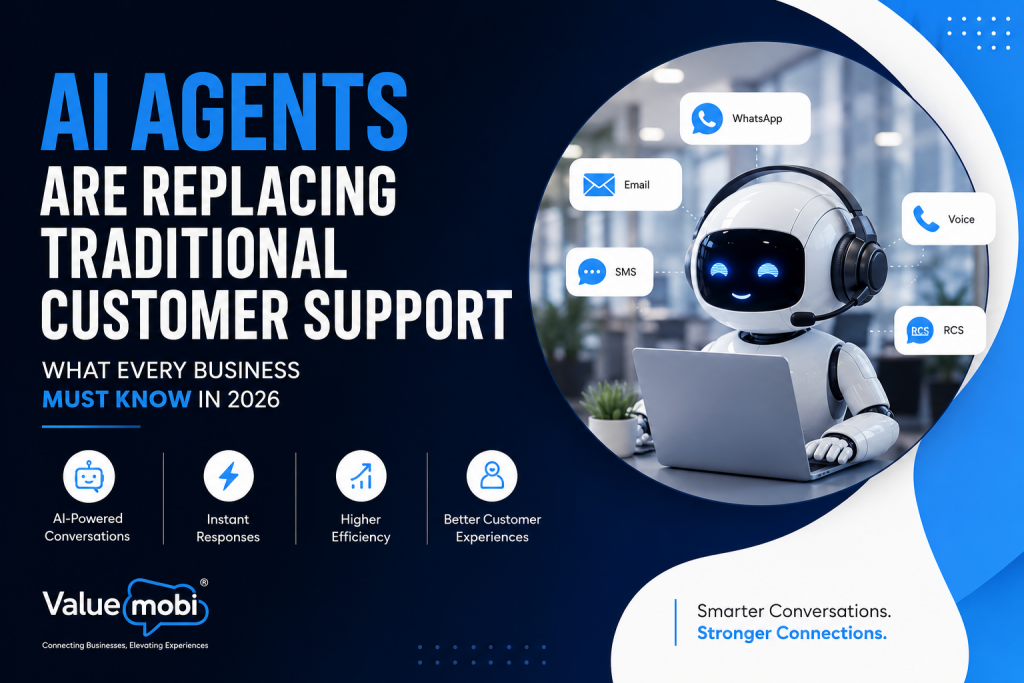
This is where AI Agents are redefining customer engagement.
Unlike traditional chatbots that rely on scripted responses and limited decision-making, AI Agents can understand context, analyze customer intent, retrieve relevant information, perform tasks, and deliver natural conversations across multiple communication channels. They don’t just answer questions—they actively help customers complete actions, resolve issues, and move conversations forward.
In 2026, organizations across industries—including banking, healthcare, retail, e-commerce, logistics, telecom, education, and travel—are rapidly integrating AI Agents into their customer support strategies. The objective isn’t to replace human employees entirely but to create a smarter collaboration where AI handles repetitive, high-volume interactions while human experts focus on complex cases that require empathy, judgment, and relationship-building.
This evolution is transforming customer service into something far more efficient, scalable, and customer-centric.
What Exactly Are AI Agents?
The term “AI Agent” has become one of the most talked-about concepts in business technology, but many people still confuse AI Agents with conventional chatbots.
The difference is significant.
Traditional chatbots typically follow predefined rules. They recognize keywords, present fixed options, and struggle whenever customers ask unexpected questions.
AI Agents operate differently.
Powered by advanced language models, machine learning, and contextual understanding, AI Agents are capable of interpreting natural conversations, remembering context, accessing business systems, and making intelligent decisions based on available information.
Instead of simply answering:
“Your order is on the way.”
An AI Agent can:
- Verify customer identity.
- Check real-time order status.
- Estimate delivery time.
- Offer alternative delivery options.
- Update delivery preferences.
- Process cancellations or returns.
- Escalate to a human agent when necessary.
The conversation feels far more natural because the AI understands the customer’s objective rather than searching for matching keywords.
Why Businesses Are Moving Beyond Traditional Customer Support
Customer service has evolved from being a support function into one of the most important drivers of business growth.
Every interaction influences how customers perceive a brand.
Unfortunately, traditional support teams often face several challenges:
- Long response times
- High operational costs
- Limited business hours
- Inconsistent service quality
- Difficulty handling sudden spikes in demand
- Repetitive questions consuming valuable staff time
During seasonal sales, product launches, or marketing campaigns, these challenges become even more noticeable.
Customers become frustrated when they cannot receive immediate assistance.
AI Agents solve these problems by remaining available around the clock, responding instantly, and handling thousands of conversations simultaneously without compromising consistency.
Rather than replacing support teams, AI allows businesses to use human expertise more effectively.
The Biggest Difference Between Chatbots and AI Agents
Many organizations still believe they already use AI because they implemented a chatbot several years ago.
In reality, most of those systems are rule-based automation tools.
An AI Agent brings a completely different level of intelligence.
| Traditional Chatbot | AI Agent |
|---|---|
| Script-based replies | Natural conversations |
| Keyword matching | Intent understanding |
| Limited workflows | Multi-step task completion |
| Static responses | Context-aware communication |
| Basic FAQs | Personalized assistance |
| Limited learning | Continuous improvement |
This shift represents one of the biggest advancements in customer communication over the last decade.
Customers Expect Conversations—Not Tickets
Consumers don’t think in terms of support tickets.
They think in terms of problems they want solved.
Whether someone contacts a company through WhatsApp, SMS, Voice, RCS, Email, or a website, they expect the experience to continue seamlessly without repeating information every time the conversation changes channels.
Modern AI Agents make this possible.
Instead of treating every interaction as a new request, AI maintains context throughout the customer journey.
Imagine a customer beginning a conversation on WhatsApp, continuing it through a voice call, and receiving a follow-up confirmation via email.
To the customer, it feels like one continuous conversation.
This omnichannel experience is becoming the new standard for customer engagement.
How AI Agents Improve Customer Experience
One of the biggest strengths of AI Agents is their ability to deliver highly personalized experiences at scale.
Rather than providing generic answers, AI Agents analyze customer history, previous interactions, preferences, and current requests before generating responses.
For example, when a returning customer contacts an e-commerce company, the AI Agent can instantly identify:
- Previous purchases
- Current orders
- Loyalty status
- Delivery preferences
- Open support requests
- Frequently purchased products
Instead of asking customers to explain everything again, the AI already understands the context.
The result is faster service, reduced frustration, and significantly higher customer satisfaction.
AI Agents Are Changing Every Industry
The adoption of AI Agents extends far beyond technology companies.
Financial institutions use AI Agents to help customers check account balances, report lost cards, verify transactions, and answer policy-related questions.
Healthcare providers assist patients with appointment scheduling, prescription reminders, and general health information while reducing pressure on front-desk staff.
Retail businesses recommend products, manage returns, track deliveries, and recover abandoned shopping carts.
Telecom companies automate recharge support, troubleshooting, plan upgrades, and complaint resolution.
Educational institutions answer admission inquiries, assist students with documentation, and provide instant information around the clock.
Regardless of industry, the underlying objective remains the same: provide faster, smarter, and more consistent customer experiences while improving operational efficiency.
AI + Human Collaboration: The Winning Formula for Customer Support
One of the biggest misconceptions surrounding AI Agents is that they are designed to replace customer service teams entirely. In reality, the most successful organizations are not replacing humans—they are empowering them.
Think about a busy customer support center. Every day, agents answer hundreds of repetitive questions:
- Where is my order?
- How do I reset my password?
- What are your business hours?
- How can I update my address?
- What documents are required?
- Can I track my application?
These repetitive interactions consume valuable time that could be better spent helping customers with more complex issues.
AI Agents take over these routine conversations, allowing human representatives to focus on situations that require empathy, negotiation, creative thinking, or technical expertise.
Instead of replacing people, AI removes repetitive work.
This creates a more productive workplace while significantly improving the customer experience.
Businesses adopting this hybrid approach are seeing faster response times, lower operational costs, and higher customer satisfaction scores.
The future isn’t AI versus humans.
It’s AI working alongside humans.
Voice AI Is Becoming the New Customer Experience Standard
For years, customers have been frustrated by robotic IVR systems that force them to press endless buttons before finally reaching the right department.
“Press 1 for Sales.”
“Press 2 for Billing.”
“Press 3 for Support.”
Most customers simply want to explain their issue naturally.
Voice AI changes this experience completely.
Modern AI Voice Agents can understand spoken language, identify customer intent, retrieve information instantly, and respond naturally without forcing customers through complicated menu systems.
Instead of navigating a maze of options, customers can simply say:
“I’d like to know when my package will arrive.”
Within seconds, the AI Agent identifies the customer, checks the order status, and provides an accurate update—all without human intervention.
Voice AI is particularly valuable for industries that receive high call volumes, including banking, healthcare, travel, insurance, logistics, utilities, and telecom.
Customers receive immediate assistance, while businesses reduce call handling time and improve service quality.
Why Omnichannel Communication Matters More Than Ever
Today’s customers rarely stick to a single communication channel.
A conversation may begin on WhatsApp during the morning commute, continue through email at work, move to a voice call in the afternoon, and end with an SMS confirmation.
Customers don’t see these as separate conversations.
They expect one continuous experience.
Unfortunately, many businesses still manage each channel independently.
This creates fragmented communication where customers are repeatedly asked to explain their issue every time they switch platforms.
Modern CPaaS platforms eliminate this problem.
By connecting SMS, WhatsApp, Email, Voice, RCS, and web chat into a unified communication platform, businesses gain a complete view of every customer interaction.
Support becomes faster, smarter, and more personalized because every conversation carries its context forward.
For customers, it feels effortless.
For businesses, it means higher engagement and stronger relationships.
The Rise of AI-Powered WhatsApp Business
WhatsApp has evolved far beyond a personal messaging app.
For millions of customers, it has become their preferred way to communicate with businesses.
Instead of waiting on hold or filling out lengthy contact forms, customers can simply send a message and receive immediate assistance.
AI-powered WhatsApp solutions allow businesses to:
- Answer frequently asked questions instantly.
- Qualify new leads automatically.
- Schedule appointments.
- Send payment reminders.
- Track deliveries.
- Share invoices.
- Collect customer feedback.
- Process service requests.
More importantly, AI ensures conversations remain available 24 hours a day.
Whether a customer sends a message at midnight or early in the morning, assistance is always available.
For businesses, this translates into faster lead conversion, higher customer satisfaction, and improved operational efficiency.
RCS Messaging: The Next Evolution Beyond SMS
While SMS remains one of the most reliable communication channels, Rich Communication Services (RCS) is redefining what business messaging can achieve.
Unlike traditional text messages, RCS supports:
- Verified business profiles.
- High-resolution images.
- Videos.
- Product carousels.
- Interactive buttons.
- Maps.
- Rich branding.
- Suggested replies.
- Real-time engagement tracking.
Instead of sending plain text, businesses can create interactive conversations that feel more like a mobile application than a traditional message.
Imagine receiving a flight update with a live boarding pass, a banking notification with secure action buttons, or an online shopping message displaying product images and delivery tracking—all within the messaging app itself.
For brands focused on customer engagement, RCS represents the future of business messaging.
AI Agents Are Revolutionizing Sales—Not Just Customer Support
Many organizations still view AI Agents purely as customer service tools.
In reality, some of the biggest business benefits come from sales and marketing.
An intelligent AI Agent can engage website visitors the moment they arrive, ask qualifying questions, recommend products, schedule demos, and even guide potential customers through the buying journey.
Rather than waiting for a sales representative to become available, prospects receive immediate assistance.
AI can identify high-intent buyers, prioritize leads, and automatically pass qualified opportunities to the sales team with complete conversation history.
This reduces response time, improves lead quality, and increases conversion rates.
For businesses, it means generating more revenue without proportionally increasing sales headcount.
The Cost of Ignoring AI in Customer Communication
Some businesses still believe AI adoption can wait.
Unfortunately, customer expectations are changing faster than ever.
Consumers increasingly expect instant responses, personalized experiences, and seamless communication across channels.
Organizations that continue relying solely on traditional support models risk:
- Longer response times.
- Higher support costs.
- Increased customer frustration.
- Lower customer retention.
- Missed sales opportunities.
- Reduced competitiveness.
Meanwhile, businesses embracing AI-powered communication are delivering faster service, building stronger customer relationships, and scaling operations without dramatically increasing staffing costs.
In today’s digital economy, customer experience has become one of the most important competitive advantages.
Ignoring AI is no longer simply delaying innovation—it can mean falling behind competitors who are already meeting customers where they are with faster, smarter, and more personalized interactions.
How to Successfully Implement AI Agents in Your Business
The idea of introducing AI Agents into customer communication may sound complex, but successful implementation is less about technology and more about understanding your customers.
Many organizations make the mistake of trying to automate everything from day one. Instead, the most effective strategy is to identify repetitive, high-volume interactions that consume the majority of your support team’s time. Questions about order status, account information, appointment scheduling, payment reminders, service requests, FAQs, and lead qualification are excellent starting points.
Once these workflows are automated, businesses can gradually expand AI capabilities into sales assistance, customer onboarding, technical troubleshooting, feedback collection, and proactive engagement.
Equally important is selecting a communication platform that supports every customer touchpoint. Modern consumers move freely between WhatsApp, SMS, Voice, Email, RCS, websites, and mobile applications. Your AI Agent should follow the customer—not force the customer to change channels.
Security should also be a priority. Customer conversations often include sensitive information, making compliance, encryption, access control, and audit trails essential. A reliable CPaaS provider ensures every interaction is protected while maintaining regulatory compliance.
The final piece is continuous improvement. AI Agents become smarter over time by analyzing conversation history, customer behavior, and frequently asked questions. Businesses that regularly monitor analytics and optimize conversation flows achieve significantly better results than those who simply deploy automation and leave it unchanged.
Successful AI adoption is an ongoing strategy—not a one-time project.
Why AI Agents Need a Powerful Communication Platform
Even the smartest AI Agent is only as effective as the communication infrastructure behind it.
Imagine an intelligent assistant that understands customer intent perfectly but cannot deliver WhatsApp messages reliably, struggles with voice quality, lacks SMS delivery, or cannot maintain conversation history across channels. The customer experience quickly breaks down.
This is where Communication Platform as a Service (CPaaS) becomes essential.
A modern CPaaS platform acts as the backbone of intelligent customer engagement, connecting every communication channel through a single, scalable infrastructure.
Instead of managing multiple vendors and disconnected systems, businesses gain one unified platform for:
- SMS Messaging
- WhatsApp Business API
- Rich Communication Services (RCS)
- Email Communication
- Voice Calling
- IVR Solutions
- Virtual Numbers
- Toll-Free Services
- AI Chatbots
- Voice Bots
- Marketing Automation
- Customer Engagement Analytics
This unified approach creates consistent customer experiences while reducing operational complexity.
How ValueMobi Helps Businesses Build Smarter Customer Experiences
Businesses today don’t simply need another messaging provider—they need a communication partner capable of supporting long-term digital transformation.
ValueMobi was built around this philosophy.
As an Indian Communication Platform as a Service (CPaaS) provider, ValueMobi enables organizations to manage customer conversations across multiple digital channels from one integrated platform.
Whether a customer reaches your business through SMS, WhatsApp, Email, RCS, or Voice, ValueMobi helps ensure every interaction is timely, reliable, and personalized.
Beyond communication channels, ValueMobi empowers organizations with intelligent automation through AI-powered conversational bots, marketing automation tools, cloud-based APIs, and scalable enterprise communication solutions.
From customer acquisition and lead nurturing to after-sales support and customer retention, businesses can create connected experiences throughout the entire customer lifecycle.
Industries including Banking, Financial Services, Insurance, Healthcare, Automotive, Retail, E-commerce, Technology, Logistics, Education, Hospitality, and Telecom increasingly rely on intelligent communication platforms to remain competitive in a rapidly evolving digital marketplace.
As customer expectations continue to rise, businesses require technology that scales without compromising quality.
That’s exactly where ValueMobi delivers value.
Real-World Business Scenarios Where AI Agents Make a Difference
To understand the true impact of AI Agents, consider how different industries are already transforming everyday customer interactions.
Banking and Financial Services
Instead of waiting in call queues, customers can instantly check account balances, download statements, locate nearby branches, apply for loans, or receive transaction alerts through conversational AI.
Healthcare
Patients can schedule appointments, receive prescription reminders, access diagnostic reports, and ask common healthcare questions without placing a phone call.
E-commerce
Customers receive personalized product recommendations, live order tracking, return assistance, payment support, and delivery updates in real time.
Automotive
Dealerships automate service bookings, maintenance reminders, warranty information, roadside assistance, and test-drive scheduling through intelligent conversations.
Education
Universities answer admission inquiries, collect documentation, schedule counseling sessions, and guide prospective students throughout the enrollment process.
Travel and Hospitality
Hotels and travel companies automate reservations, booking confirmations, itinerary changes, room upgrades, airport transfers, and customer feedback collection.
Across every industry, the goal remains the same—deliver faster service while creating memorable customer experiences.
The Future of AI Agents Beyond 2026
The AI revolution is only beginning.
Over the next few years, AI Agents will evolve from answering customer questions to becoming autonomous digital employees capable of completing entire business processes.
Future AI Agents will not simply provide information—they will negotiate appointments, manage subscriptions, recommend products based on customer behavior, process claims, complete transactions, analyze sentiment, predict customer needs, and collaborate with multiple business systems simultaneously.
Voice interactions will become increasingly natural, making conversations almost indistinguishable from speaking with a human representative.
Predictive AI will proactively contact customers before issues arise.
Imagine receiving a message that your vehicle requires servicing before a fault occurs, your insurance policy is about to expire, your bank has detected unusual spending, or your package has been delayed—all automatically.
Businesses adopting these technologies today will be better prepared for the next generation of customer engagement.
The future belongs to organizations that communicate intelligently, proactively, and personally.
Frequently Asked Questions
Are AI Agents replacing customer support employees?
No. AI Agents handle repetitive and high-volume interactions while human representatives focus on complex situations requiring empathy, decision-making, and relationship management.
How are AI Agents different from traditional chatbots?
Traditional chatbots follow predefined rules and scripts. AI Agents understand context, analyze intent, perform tasks, learn continuously, and deliver more natural conversations.
Which communication channels should businesses support?
Modern businesses should provide customers with multiple options, including WhatsApp, SMS, Email, Voice, RCS, websites, and mobile applications to ensure seamless omnichannel engagement.
Can small businesses benefit from AI Agents?
Absolutely. AI-powered customer communication is no longer limited to large enterprises. Small and medium-sized businesses can automate customer support, improve response times, reduce costs, and provide professional service without significantly increasing staff.
Why is CPaaS important for AI-powered communication?
A CPaaS platform connects all communication channels into a single infrastructure, enabling businesses to deliver consistent, secure, and scalable customer experiences while integrating AI across every interaction.
Final Thoughts
Customer support is undergoing one of the most significant transformations since the rise of digital communication.
The question is no longer whether businesses should adopt AI—it is how quickly they can integrate intelligent communication into their customer experience strategy.
Organizations that continue relying solely on traditional support models risk slower response times, higher operational costs, and declining customer satisfaction.
In contrast, businesses embracing AI Agents alongside modern communication platforms are building stronger customer relationships, improving operational efficiency, and creating experiences that customers genuinely value.
The future of customer communication is not about replacing people.
It is about empowering businesses with intelligent technology that allows every conversation to become faster, more personal, and more meaningful.
For organizations looking to modernize customer engagement, AI Agents combined with a robust CPaaS platform represent one of the most valuable investments they can make in 2026 and beyond.
Why Choose ValueMobi?
At ValueMobi, we help businesses move beyond traditional communication by bringing AI, Voice, WhatsApp Business API, SMS, Email, RCS, and intelligent automation together on one scalable platform.
Whether you’re looking to improve customer support, automate sales conversations, reduce operational costs, or create exceptional customer experiences, ValueMobi provides the technology and expertise to help you communicate smarter.
Ready to transform your customer communication?
Visit: https://www.vmobi.in
Explore intelligent communication solutions that help your business stay connected, responsive, and future-ready.